
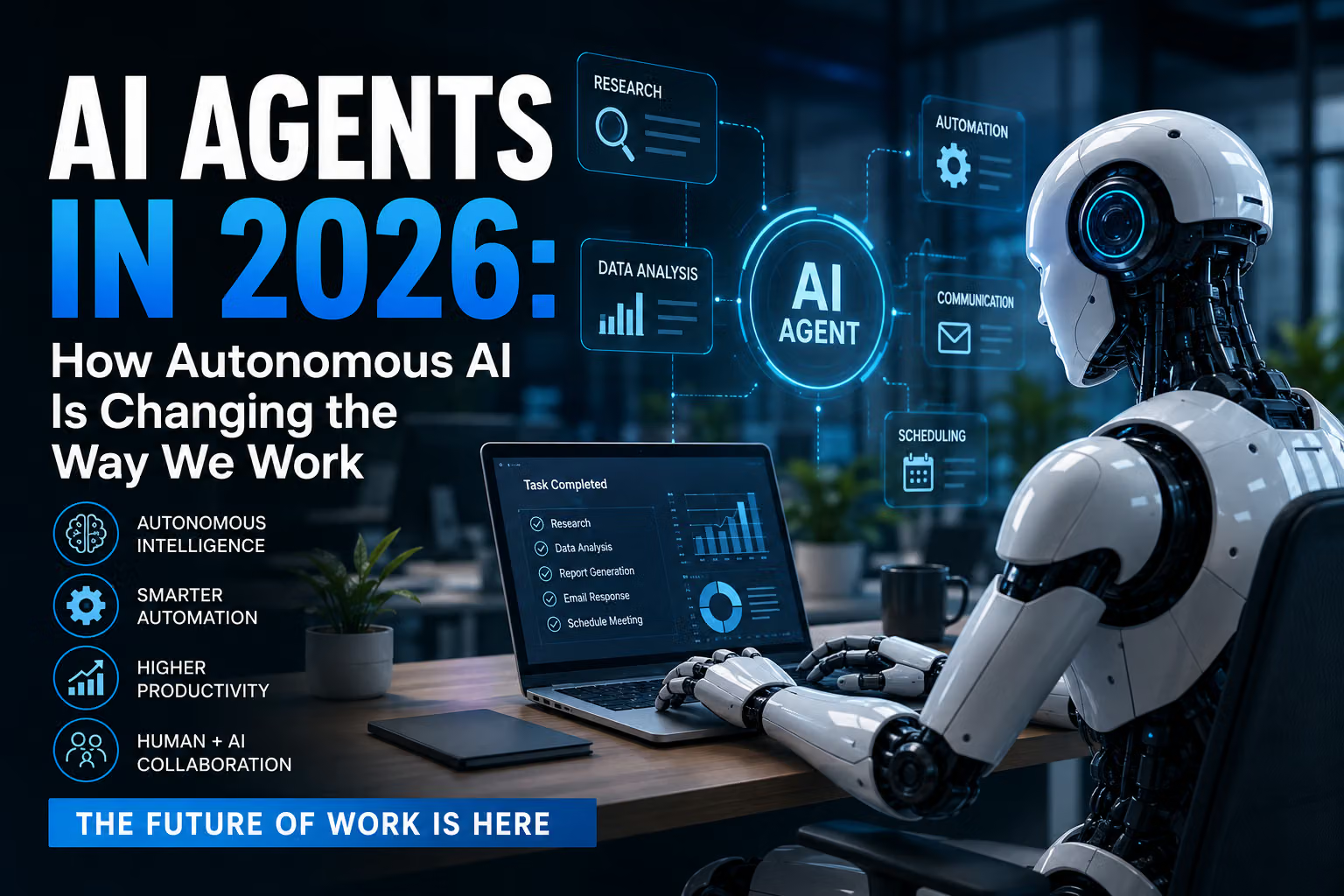
Artificial intelligence is entering a new phase. Early AI tools were mainly designed to answer questions, generate text, create images, or analyze information. Newer AI systems are increasingly being developed to perform multiple steps toward a goal.
These systems are often described as AI agents.
Instead of simply responding to a question, an AI agent can potentially understand an objective, break it into smaller tasks, use available tools, evaluate results, and continue working toward the requested outcome.
This development could have a significant impact on businesses and workers in the United States.
AI agents may eventually assist with customer service, software development, research, scheduling, data analysis, marketing, sales, and other business processes.
But the technology also raises important questions about accuracy, security, privacy, human oversight, and the future of work.
What Is an AI Agent?
An AI agent is an AI-powered system designed to accomplish a task or goal by taking multiple actions rather than simply generating a single response.
A traditional chatbot might answer:
“How do I create a marketing plan?”
An AI agent could potentially be given a broader objective such as:
“Create a marketing campaign for our new product.”
Depending on its tools and permissions, an agent could potentially break that request into smaller steps, such as researching the target audience, creating campaign ideas, drafting content, organizing tasks, and preparing a report.
The exact capabilities depend on the specific AI system and the tools connected to it.
How Are AI Agents Different From Chatbots?
The biggest difference is the degree of autonomy and task execution.
A traditional chatbot primarily communicates with the user.
An AI agent can be designed to take actions toward a goal.
For example:
Chatbot:
User asks a question → AI generates an answer.
AI agent:
User provides a goal → AI plans tasks → AI uses available tools → AI performs steps → AI evaluates results → AI reports back.
This does not mean every AI agent operates completely independently.
Many systems still require human approval before taking important actions.
Why AI Agents Matter for American Businesses
Businesses in the United States perform thousands of repetitive digital tasks every day.
Employees may spend time:
- Reading emails
- Entering data
- Updating spreadsheets
- Scheduling meetings
- Preparing reports
- Answering common questions
- Organizing documents
- Monitoring business processes
- Creating routine content
Some of these tasks can potentially be automated or partially automated with AI agents.
For companies, the attraction is not necessarily replacing every human task.
Instead, businesses may use AI agents to reduce repetitive work and allow employees to focus on activities requiring judgment, creativity, communication, and decision-making.
1. AI Agents in Customer Service
Customer support is one potential application.
An AI agent could potentially handle routine requests such as:
- Order-status questions
- Appointment scheduling
- Basic troubleshooting
- Frequently asked questions
- Account-related requests
More complicated cases could be transferred to a human representative.
This could allow customer-service teams to spend more time on issues that require human judgment.
However, companies need safeguards to prevent agents from providing incorrect information or making unauthorized changes to customer accounts.
2. AI Agents in Software Development
Software development is another area where AI agents could become increasingly useful.
An agent could potentially assist with several stages of a development task.
For example:
- Understand a software requirement.
- Create an implementation plan.
- Generate code.
- Run tests.
- Identify errors.
- Modify the code.
- Run additional tests.
- Prepare documentation.
This is different from simply asking an AI to generate a code snippet.
The agent can potentially work through a longer sequence of actions.
Developers still need to review generated code carefully, particularly when security, privacy, or production systems are involved.
3. AI Agents for Research
Research tasks can involve multiple steps.
A person may need to collect information from different sources, organize it, compare findings, and prepare a report.
An AI agent could potentially assist with parts of this workflow.
For example, a research workflow might involve:
- Identifying relevant sources
- Collecting information
- Organizing notes
- Comparing data
- Creating a summary
The major challenge is reliability.
An agent may misunderstand a source, select poor-quality information, or make incorrect conclusions.
Human verification therefore remains important, especially for professional or high-stakes research.
4. AI Agents in Marketing
Marketing teams can potentially use AI agents for repetitive digital workflows.
An agent could assist with:
- Content planning
- Campaign ideas
- Audience research
- Email drafts
- Social media scheduling
- Performance summaries
- A/B test analysis
Businesses may eventually create workflows where AI systems monitor campaign information and suggest changes based on predefined rules.
Human marketers would still need to determine overall strategy and review important decisions.
5. AI Agents for Small Businesses
Small businesses may benefit significantly from AI automation because they often operate with smaller teams.
A small business owner might use AI agents to help organize:
- Customer inquiries
- Appointment requests
- Marketing tasks
- Inventory information
- Business documents
- Administrative workflows
For a company with only a few employees, reducing repetitive administrative work could potentially free up time for customer relationships and business development.
However, small businesses also need to consider costs, reliability, data security, and whether automation actually saves time.
6. AI Agents and Email
Email is another potential area for AI automation.
An AI agent could potentially categorize incoming messages, summarize long conversations, identify action items, or draft responses.
For example, an agent might identify emails requiring a response and prepare suggested replies.
The user could then review and approve them.
More advanced systems could potentially perform certain predefined actions automatically.
Because email accounts can contain sensitive information, users should pay particular attention to permissions and security when connecting AI systems.
7. AI Agents and Scheduling
Scheduling is often repetitive.
An AI agent could potentially help coordinate calendars, identify available times, prepare meeting invitations, and send reminders.
Instead of manually exchanging multiple messages about availability, a user could provide the objective and allow the system to handle routine scheduling steps.
Human approval may still be required for important meetings or sensitive communications.
8. AI Agents in Finance and Accounting
Businesses also perform many repetitive financial tasks.
AI systems may assist with:
- Organizing invoices
- Categorizing transactions
- Preparing reports
- Identifying unusual patterns
- Summarizing financial information
However, financial information is highly sensitive.
Organizations should use appropriate security controls and human review.
AI should not be allowed to independently make significant financial decisions without appropriate safeguards.
9. AI Agents and Cybersecurity
AI agents could have both defensive and offensive implications for cybersecurity.
On the defensive side, AI systems can potentially help security teams monitor large amounts of information, identify suspicious patterns, prioritize alerts, and automate routine responses.
This could be valuable because security teams often have to process large volumes of alerts.
However, attackers can also use AI to make scams, phishing campaigns, and other attacks more sophisticated.
This means organizations will need stronger security practices as AI capabilities increase.
10. What Are the Risks of AI Agents?
Greater autonomy creates greater risks.
An AI system that only produces text has limited ability to directly affect the outside world.
An AI agent connected to email, databases, financial systems, or business software could potentially take actions that have real consequences.
Potential risks include:
Incorrect Decisions
An agent could misunderstand its instructions or make an incorrect judgment.
Security Problems
Poorly secured agents could expose sensitive information or allow unauthorized actions.
Privacy Risks
Agents may process large amounts of personal or business information.
Excessive Permissions
An agent should generally have only the permissions necessary for its assigned task.
Lack of Human Oversight
Important actions may require human approval rather than full automation.
Human Oversight Is Still Important
AI agents may automate tasks, but that does not eliminate the need for people.
Human oversight can be particularly important when decisions involve:
- Money
- Legal matters
- Employment
- Healthcare
- Personal data
- Security
- Customer rights
A useful model for many organizations may be “human in the loop.”
Under this approach, AI handles routine steps while a person reviews important decisions.
Will AI Agents Replace Jobs?
AI agents could change the tasks performed by workers, but the effect will vary significantly by occupation and industry.
Some repetitive tasks may become more automated.
At the same time, new responsibilities may emerge around managing AI systems, checking outputs, designing workflows, handling exceptions, and maintaining security.
For many workers, the more immediate change may be that AI becomes another tool used during the workday.
The overall impact will depend on how quickly organizations adopt the technology, how capable the systems become, and how businesses redesign their workflows.
Skills Workers May Need
As AI becomes more capable, workers may benefit from developing skills that complement AI.
These can include:
- Critical thinking
- Communication
- Problem solving
- Data literacy
- AI literacy
- Domain expertise
- Creativity
- Project management
- Cybersecurity awareness
Understanding how to evaluate AI output may become nearly as important as knowing how to generate it.
What Will AI Agents Look Like in the Future?
The next stage of AI development may involve increasingly connected systems.
Instead of using separate tools for individual tasks, a person might interact with an AI system that can coordinate several applications.
For example, a business owner could potentially say:
“Prepare this week’s sales report, identify unusual changes, summarize the findings, and create a list of questions for tomorrow’s team meeting.”
An AI system could potentially handle several steps in that workflow.
The exact level of autonomy will depend on the technology, available integrations, security controls, and permissions.
How Businesses Can Prepare
Companies considering AI agents should start with clearly defined tasks.
A practical approach is to:
- Identify repetitive workflows.
- Determine whether automation provides real value.
- Start with low-risk tasks.
- Establish security controls.
- Limit AI permissions.
- Require human approval for sensitive actions.
- Monitor performance.
- Review AI-generated results.
- Train employees.
- Update policies as technology changes.
This approach can help organizations experiment with AI while managing potential risks.
Frequently Asked Questions
What is an AI agent?
An AI agent is an AI-powered system designed to accomplish goals by planning and performing multiple actions using available tools.
Are AI agents the same as chatbots?
No. A chatbot primarily focuses on conversation, while an AI agent may be designed to perform multi-step tasks and interact with external tools.
Can AI agents work without humans?
Some agents can operate with a degree of autonomy, but the amount of human involvement depends on the system and task. Sensitive actions often require human oversight.
Can AI agents replace workers?
AI agents may automate some tasks and change job responsibilities, but their impact will vary across industries and occupations.
Are AI agents safe?
AI agents can be useful, but systems with access to external tools or sensitive data require strong security controls, limited permissions, monitoring, and appropriate human oversight.
Which businesses can use AI agents?
Potential applications exist across technology, customer service, marketing, finance, healthcare administration, education, retail, logistics, and many other industries.
Conclusion
AI agents represent an important development in artificial intelligence because they can move AI beyond simple question answering toward multi-step task execution.
For American businesses and workers, this technology could change how everyday digital work is organized.
AI agents may help with customer service, research, coding, scheduling, marketing, administration, and many other repetitive workflows.
But greater autonomy also creates greater responsibility.
Businesses need to consider privacy, cybersecurity, accuracy, permissions, and human oversight before allowing AI agents to perform important actions.
The future of AI agents is still developing, but one thing is becoming increasingly clear: AI is moving from a tool that simply provides answers toward technology that can increasingly help people accomplish complete tasks.










Leave a Reply