

Artificial intelligence has moved far beyond science fiction. In 2026, AI assistants are becoming part of everyday life for millions of people in the United States. From answering questions and writing emails to helping with research, planning trips, organizing schedules, and creating content, AI-powered tools are changing how people interact with technology.
Unlike traditional voice assistants that mainly respond to simple commands, modern AI assistants can understand natural language, maintain context during conversations, analyze information, generate content, and help users complete more complicated tasks.
For American consumers, this technology is increasingly appearing across smartphones, computers, cars, smart-home devices, productivity software, and online services.
But what exactly can AI assistants do in 2026, and how are people using them in real life? Here is a detailed look.
What Is an AI Assistant?
An AI assistant is software powered by artificial intelligence that can understand a user’s instructions and provide information or perform certain tasks.
Traditional digital assistants were primarily designed around predefined commands. For example, a user might ask a phone to set an alarm, play music, or provide the weather.
Modern AI assistants are considerably more flexible.
They can understand conversational requests such as:
- “Help me plan a three-day trip to New York.”
- “Summarize this long document.”
- “Write a professional email explaining this problem.”
- “Compare these two products.”
- “Explain this complicated topic in simple language.”
- “Help me organize my weekly schedule.”
The technology behind these systems includes large language models, machine learning, speech recognition, computer vision, and other AI technologies.
Why Are AI Assistants Becoming Popular in the USA?
One major reason is convenience.
Americans already use smartphones, laptops, smart speakers, connected cars, and online services throughout the day. AI can make many of these interactions easier.
Instead of searching through multiple websites or applications, users can communicate with an AI system using ordinary language.
For example, someone planning a vacation could ask an AI assistant to create a basic itinerary, suggest activities, organize information, and help draft messages or checklists.
A student might use an AI assistant to understand a difficult subject, create study questions, or organize notes.
A small-business owner could use AI to draft marketing copy, brainstorm ideas, summarize meetings, or create customer-service responses.
The technology is therefore moving from simple question answering toward broader productivity assistance.
1. AI for Work and Productivity
One of the biggest areas of AI adoption is the workplace.
Employees increasingly use AI tools to assist with repetitive or time-consuming tasks.
Common examples include:
- Drafting emails
- Summarizing meetings
- Creating presentations
- Analyzing documents
- Brainstorming ideas
- Writing reports
- Creating spreadsheets
- Generating marketing content
- Translating text
- Organizing information
AI does not necessarily replace the person performing the job. In many cases, it acts as a productivity tool that helps workers complete tasks faster.
For example, an employee could provide an AI assistant with notes from a meeting and ask it to organize the information into action items.
The employee can then review the result, correct mistakes, and share the final version.
This human-review step remains important because AI systems can sometimes produce inaccurate or incomplete information.
2. AI Assistants for Students
Education is another area where AI assistants are becoming increasingly visible.
Students can use AI tools to explain difficult concepts, create practice questions, summarize study material, and brainstorm ideas.
For example, instead of asking an AI simply to provide an answer to a mathematics problem, a student can ask it to explain the process step by step.
AI can also adjust explanations to different levels of understanding.
A complicated scientific concept can be explained using simple language, while an advanced student can request a more technical explanation.
However, students should not treat AI-generated information as automatically correct.
AI can make factual errors, misunderstand questions, or provide misleading information. Students should verify important facts and follow their school’s rules regarding AI use.
3. AI for Personal Planning
AI assistants can also help with everyday organization.
People can use them to create:
- Daily schedules
- Shopping lists
- Meal plans
- Travel itineraries
- Workout schedules
- Packing lists
- Budget categories
- Event checklists
The advantage is that users can describe what they want in natural language.
For example:
“I have a busy workweek and need a simple schedule for Monday through Friday.”
An AI assistant can turn that request into a structured plan.
The user can then modify it according to personal preferences.
4. AI and Smartphones
Smartphones are becoming one of the most important platforms for AI assistants.
Modern phones increasingly include AI-powered features for photography, writing, translation, search, voice interaction, and productivity.
AI can help users improve photographs, summarize notifications, rewrite messages, translate conversations, and search for information.
The integration of AI directly into mobile operating systems also means users may not always need to open a separate AI application.
Instead, AI capabilities can become part of the normal smartphone experience.
5. AI in Smart Homes
AI assistants are also becoming connected to smart-home technology.
A user may already control lights, thermostats, cameras, speakers, and other devices through apps or voice commands.
AI could make these systems more conversational.
Instead of giving several individual commands, a user could describe a desired situation and let compatible systems respond.
For example, a household could potentially create routines that adjust lighting, temperature, entertainment, and other connected devices based on a particular schedule.
However, smart-home AI also raises privacy and security questions because connected devices can collect information about household activities.
Consumers should understand what information their devices collect and review available privacy settings.
6. AI in Cars
Artificial intelligence is also playing an increasingly important role in vehicles.
Modern vehicles use software and AI-related technologies for driver assistance, navigation, safety systems, voice controls, parking assistance, and other functions.
AI-powered voice interfaces can make it easier for drivers to interact with vehicle systems without manually navigating menus.
Advanced driver-assistance technologies can also use cameras, sensors, and software to interpret the environment around a vehicle.
It is important to distinguish these systems from fully autonomous driving. The capabilities and limitations of driver-assistance technology vary significantly between vehicles and manufacturers.
Drivers should always follow the vehicle manufacturer’s instructions and remain responsible for safe operation when required.
7. AI for Small Businesses
Small businesses across the United States can also benefit from AI assistants.
A business owner may use AI for:
- Website content
- Social media ideas
- Customer-service drafts
- Market research
- Product descriptions
- Business emails
- Internal documentation
- Basic data analysis
- Brainstorming
For businesses with limited resources, AI can provide assistance with tasks that previously required additional time or specialized services.
However, companies should be careful when entering confidential customer, financial, legal, or proprietary information into AI systems.
Organizations should establish clear policies about what information employees can share with AI tools.
8. Privacy and Security Concerns
The growth of AI assistants also creates important privacy questions.
Users may share personal information with AI systems during conversations. Depending on the service and settings, information may be stored or processed in different ways.
Before using an AI assistant, consumers should review its privacy policy and available controls.
Important questions include:
- What data does the service collect?
- How is the information used?
- How long is information retained?
- Can conversations be deleted?
- Is information used to improve the service?
- What third parties may receive data?
Consumers should also avoid sharing highly sensitive information unless they understand how the service handles it.
9. AI Can Make Mistakes
Despite their impressive capabilities, AI assistants are not perfect.
They can sometimes:
- Produce incorrect facts
- Misinterpret a question
- Invent sources or information
- Give outdated answers
- Misunderstand context
- Make calculation errors
This is sometimes described as an AI “hallucination.”
For casual tasks, a small error may not be particularly serious. But mistakes can become much more important when AI is used for medical, financial, legal, employment, or other high-stakes decisions.
Users should verify important information with reliable sources and qualified professionals when appropriate.
10. What Is the Future of AI Assistants?
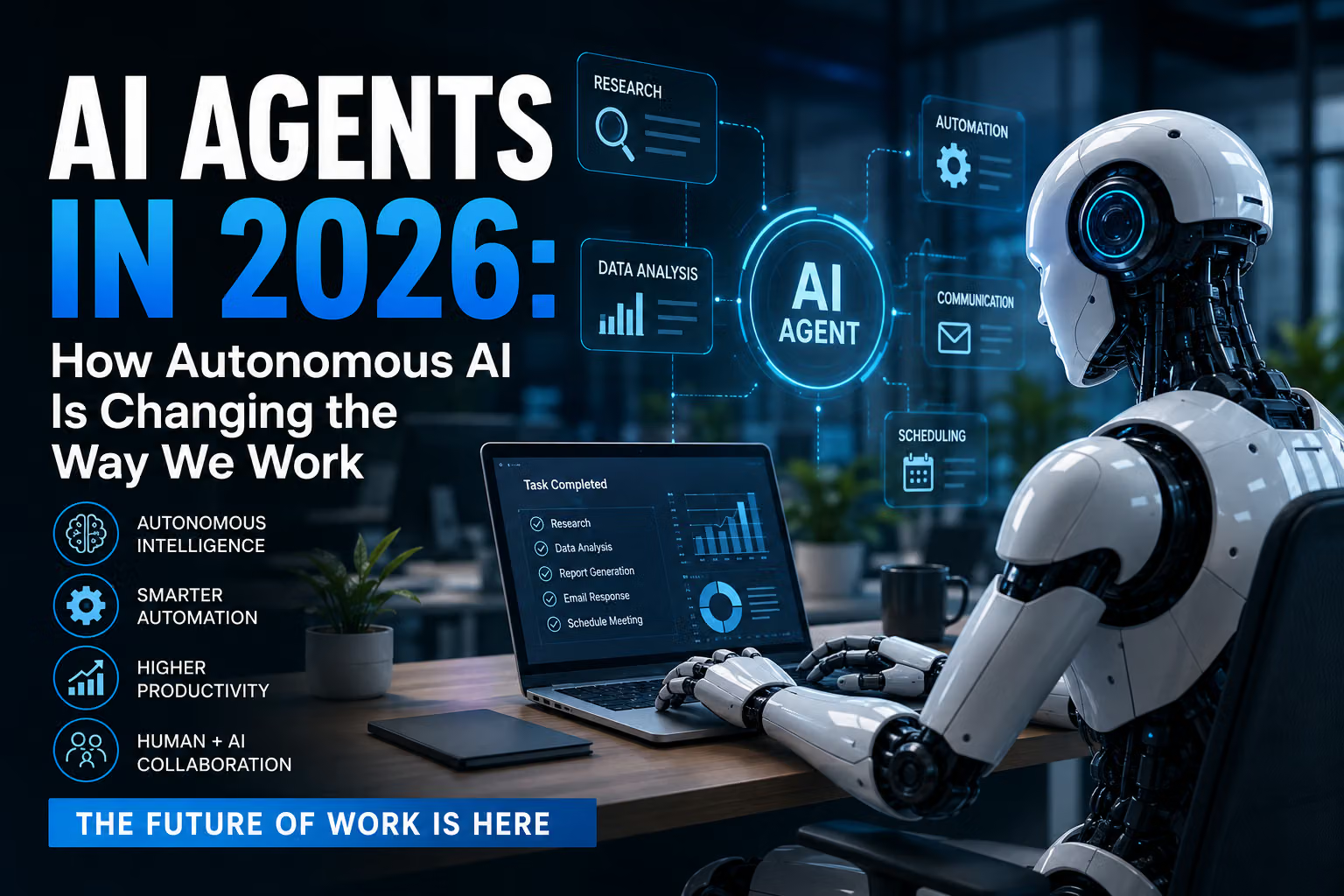
The next stage of AI development is likely to involve assistants that can do more than simply answer questions.
AI systems are increasingly moving toward task-oriented assistance.
Instead of saying:
“Tell me how to create a presentation.”
A user may eventually be able to ask:
“Create a presentation from these notes, organize the information, prepare the slides, and give me a summary.”
The assistant could potentially handle multiple steps while the user supervises the process.
This evolution could make AI more useful for work, education, business, entertainment, and everyday organization.
At the same time, questions surrounding privacy, security, accuracy, copyright, employment, and responsible AI use will remain important.
Frequently Asked Questions
What is an AI assistant?
An AI assistant is software that uses artificial intelligence to understand user requests and provide information, generate content, or assist with tasks.
Are AI assistants free?
Some AI assistants offer free versions, while others provide additional features through paid subscriptions. Pricing and features vary by service.
Can AI assistants replace human workers?
AI can automate or assist with certain tasks, but whether a particular job or role will be significantly affected depends on the industry, occupation, technology, and organization.
Are AI assistants safe?
AI assistants can be useful, but users should consider privacy, security, and accuracy. Sensitive information should be handled carefully, and important AI-generated information should be verified.
Can students use AI assistants?
Students can use AI for learning and productivity, but they should follow their school’s or instructor’s rules regarding AI-generated work.
Conclusion
AI assistants are becoming an increasingly important part of technology in the United States. Their role is expanding from basic voice commands to more sophisticated assistance with work, education, communication, planning, smart homes, smartphones, and business tasks.
The biggest change may be the way people interact with technology. Instead of learning complicated software interfaces, users can increasingly describe what they want using ordinary language.
However, AI should be viewed as a tool rather than an unquestionable source of truth. Users need to consider privacy, security, accuracy, and responsible use.
As AI technology continues to develop, the relationship between people and digital assistants is likely to become more conversational, personalized, and task-oriented.









Leave a Reply