

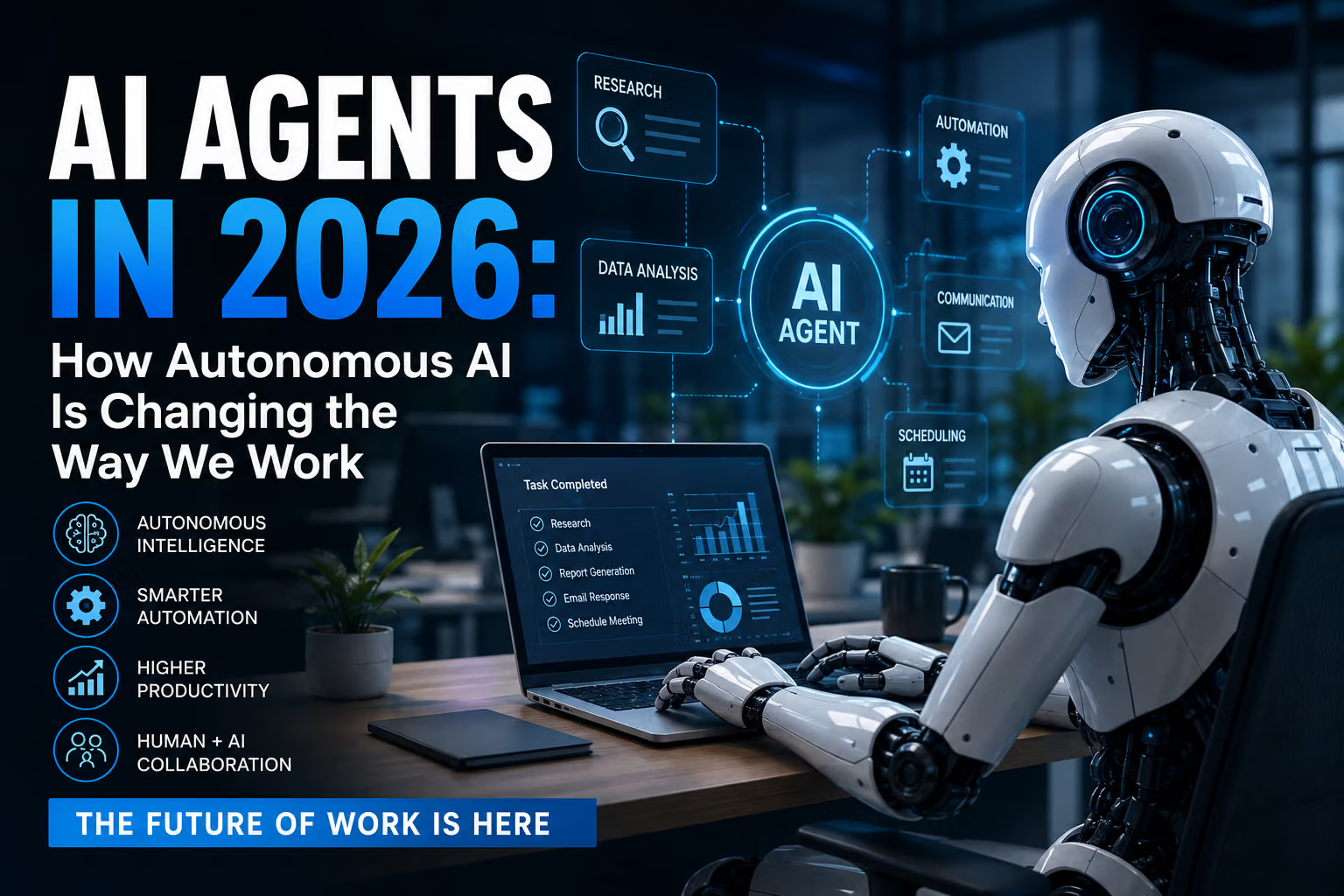
Artificial intelligence is changing the way people work across the United States. AI-powered software is increasingly being used to write documents, analyze information, create images, assist with coding, answer customer questions, summarize meetings, and automate repetitive tasks.
For American workers, the important question is not simply whether AI will affect jobs. A more practical question is how individual tasks and responsibilities may change as companies adopt increasingly capable AI tools.
The impact is unlikely to be identical across every industry or occupation. Some jobs may involve more automation, while others may use AI primarily as a productivity tool. New responsibilities can also emerge around managing, reviewing, and implementing AI systems.
Understanding these changes can help workers identify skills that may remain valuable in an increasingly AI-assisted workplace.
What Does AI Mean for the Workplace?
Artificial intelligence refers to technologies that allow computer systems to perform tasks that traditionally required human intelligence.
In the workplace, AI can be used for activities such as:
- Analyzing information
- Generating text
- Processing documents
- Recognizing patterns
- Writing and reviewing code
- Creating images
- Summarizing meetings
- Answering customer questions
- Automating repetitive workflows
The technology does not necessarily perform an entire job.
In many cases, it handles individual tasks within a larger role.
For example, a marketing employee may still develop the overall strategy but use AI to brainstorm ideas or create an initial draft.
A software developer may still design an application but use AI to generate code and identify potential errors.
This distinction between jobs and tasks is important when discussing the effect of AI on employment.
Why Companies Are Adopting AI
Businesses have several reasons for experimenting with artificial intelligence.
One major reason is productivity.
If an employee spends hours performing a repetitive digital task, an AI system may be able to reduce the amount of manual work involved.
AI can also help businesses process large amounts of information quickly.
Other potential benefits include:
- Faster content creation
- Improved workflow automation
- Faster data analysis
- Customer-service assistance
- Software development support
- Document processing
- Personalized customer experiences
However, adopting AI also creates costs and risks.
Companies need to invest in technology, employee training, cybersecurity, data governance, and quality control.
1. AI and Office Jobs
Office workers are among those increasingly exposed to AI-assisted tools.
Administrative employees may use AI to organize information, draft emails, summarize meetings, prepare documents, or manage repetitive workflows.
The role of an administrative worker could therefore shift toward coordination, communication, problem-solving, and supervision.
Instead of spending most of the day manually creating routine documents, an employee may increasingly review AI-generated drafts and focus on more complex requests.
2. AI and Customer Service
Customer-service operations are another major area of AI adoption.
AI-powered systems can handle common questions and provide automated assistance.
For example, a customer might ask about:
- Store hours
- Order status
- Product information
- Appointment scheduling
- Basic troubleshooting
If the issue is more complicated, the system can potentially transfer the conversation to a human representative.
This could change the role of customer-service workers.
Instead of answering every basic question, employees may increasingly focus on complicated cases that require empathy, judgment, negotiation, or specialized knowledge.
3. AI and Software Development
AI is also changing software development.
Modern coding assistants can help developers generate code, explain programming concepts, identify potential problems, and create tests.
This does not mean programming becomes completely automated.
Software developers still need to understand requirements, architecture, security, performance, testing, and business objectives.
In fact, as AI generates more code, reviewing and validating that code can become increasingly important.
Developers may need to spend more time evaluating AI-generated solutions rather than writing every line manually.
4. AI and Marketing
Marketing professionals can use AI for many creative and analytical tasks.
Possible applications include:
- Brainstorming campaigns
- Writing initial drafts
- Creating customer segments
- Summarizing research
- Generating social media ideas
- Analyzing marketing data
- Personalizing communications
However, effective marketing still requires understanding people, brands, markets, and business objectives.
AI can generate many ideas, but humans need to determine which ideas are appropriate and effective.
5. AI and Healthcare
Healthcare is another area where AI is being developed and used for various applications.
AI-related technologies can assist with administrative tasks, information processing, documentation, research, and other workflows.
Healthcare professionals, however, operate in an environment where accuracy and safety are particularly important.
AI systems should therefore be implemented with appropriate safeguards, professional oversight, and attention to privacy.
The role of healthcare professionals involves much more than processing information. Communication, clinical judgment, ethical considerations, and patient relationships remain important.
6. AI and Finance
Financial companies can use AI to analyze large amounts of information and automate certain processes.
Potential applications include:
- Fraud detection
- Customer support
- Document processing
- Data analysis
- Risk analysis
- Financial research
At the same time, financial applications can involve significant risks.
Incorrect AI output can have serious consequences when used for financial decisions.
Human review, regulatory requirements, security, and data governance therefore remain important.
7. AI and Creative Careers
Writers, designers, photographers, video creators, and other creative professionals are also seeing changes.
Generative AI can produce text, images, audio, and video.
This gives creators new tools for experimentation and production.
A designer might use AI to generate initial concepts.
A writer might use AI to brainstorm ideas.
A video creator might use AI for scripting or editing assistance.
However, originality, storytelling, taste, cultural understanding, and creative direction remain human strengths.
The creative process may therefore shift rather than simply disappear.
Will AI Eliminate Jobs?
AI can automate certain tasks, but predicting exactly how many jobs will disappear is difficult.
The outcome depends on several factors:
- How quickly businesses adopt AI
- How capable AI systems become
- The cost of implementation
- Government regulations
- Consumer behavior
- Economic conditions
- The nature of individual occupations
- Whether AI complements or substitutes human work
Some occupations may experience significant automation of certain tasks, while others may primarily use AI as an assistant.
New jobs and responsibilities can also emerge.
Jobs May Change Instead of Disappear
One important possibility is job transformation.
Consider an accountant.
AI may automate some repetitive data-processing tasks.
But the accountant may spend more time interpreting information, communicating with clients, reviewing unusual situations, and advising businesses.
Similarly, a marketing professional may spend less time producing routine drafts and more time developing strategy.
A customer-service employee may handle fewer simple inquiries but more complex customer problems.
In this way, AI can change the composition of a job without necessarily eliminating the entire occupation.
Skills That May Become More Valuable
As AI becomes more common, workers may benefit from developing skills that complement artificial intelligence.
Critical Thinking
Workers need to determine whether AI-generated information is accurate and useful.
Communication
Clear communication remains important because people must explain goals, review results, and work with customers and colleagues.
Domain Expertise
AI can generate information, but specialized knowledge helps people recognize mistakes and make informed decisions.
Problem Solving
Complex problems often require understanding context and choosing among different options.
AI Literacy
Workers increasingly need to understand what AI tools can and cannot do.
Data Literacy
Understanding data, statistics, and basic analysis can help employees work effectively with AI-powered systems.
Creativity
AI can generate possibilities, but humans remain responsible for deciding what is meaningful, useful, and appropriate.
The Rise of AI Literacy
AI literacy could become an important workplace skill.
Employees do not necessarily need to become AI engineers.
Instead, they may need to understand:
- How AI systems work at a basic level
- How to write effective instructions
- How to verify AI output
- How to identify potential errors
- How to protect confidential information
- When human judgment is required
This can help workers use AI more effectively while avoiding common mistakes.
How Workers Can Prepare
Workers who want to adapt to AI-driven changes can take several practical steps.
Learn the AI Tools Used in Your Industry
Start with the tools relevant to your current job rather than trying to learn every AI product available.
Automate Repetitive Tasks
Identify routine work that can potentially be assisted by AI.
Improve Human Skills
Communication, leadership, creativity, critical thinking, and relationship-building remain valuable.
Build Industry Knowledge
Strong domain expertise can help workers evaluate AI output and solve complex problems.
Keep Learning
AI technology is changing rapidly. Continuous learning can help workers adapt as tools and workflows evolve.
What Employers Need to Consider
Companies also have responsibilities when introducing AI into the workplace.
They should consider:
- Employee training
- Data privacy
- Cybersecurity
- AI accuracy
- Bias and fairness
- Human oversight
- Appropriate use policies
- Regulatory requirements
Simply purchasing an AI tool does not guarantee productivity improvements.
Companies need to understand where AI genuinely adds value.
AI and the Future of Remote Work
AI may also influence remote and hybrid work.
Digital assistants can help summarize meetings, organize projects, draft communications, and manage information across distributed teams.
This could reduce some administrative friction for remote workers.
However, AI does not eliminate the need for communication and collaboration.
Human teams still need clear goals, accountability, trust, and effective management.
AI Skills for the Next Generation of Workers
Students and younger workers entering the workforce may increasingly encounter AI from their first day on the job.
Useful skills may include:
- Digital literacy
- AI literacy
- Coding fundamentals
- Data analysis
- Communication
- Critical thinking
- Adaptability
- Industry expertise
The ability to work effectively with AI may become similar to other basic workplace technology skills.
Frequently Asked Questions
Will AI replace all jobs in the USA?
There is no evidence that all jobs will simply disappear. AI is more likely to affect different occupations and tasks in different ways.
Which jobs are most affected by AI?
Jobs involving large amounts of repetitive digital or information-processing work may have greater exposure to AI assistance, but the impact varies by occupation and implementation.
Should workers learn AI?
Learning how relevant AI tools work can help workers understand where the technology can improve productivity and where human judgment remains necessary.
Will AI create new jobs?
AI adoption can create new technical and non-technical responsibilities, although the exact number and type of future jobs are uncertain.
Is AI useful for small businesses?
AI can assist small businesses with tasks such as content creation, customer-service drafts, research, administration, and workflow automation.
Conclusion
Artificial intelligence is changing workplaces across the United States by altering how many tasks are performed.
The most important change may not be the complete replacement of human workers but the increasing collaboration between people and AI systems.
Some repetitive tasks may become automated, while employees may spend more time on problem-solving, communication, creativity, strategy, and decision-making.
For workers, developing AI literacy alongside strong human and industry-specific skills can help them adapt to changing workplace expectations.
For employers, successful AI adoption will require more than technology. Training, security, privacy, human oversight, and responsible implementation will also matter.
The future of work will continue to evolve as AI becomes more capable and more deeply integrated into everyday business operations.










Leave a Reply